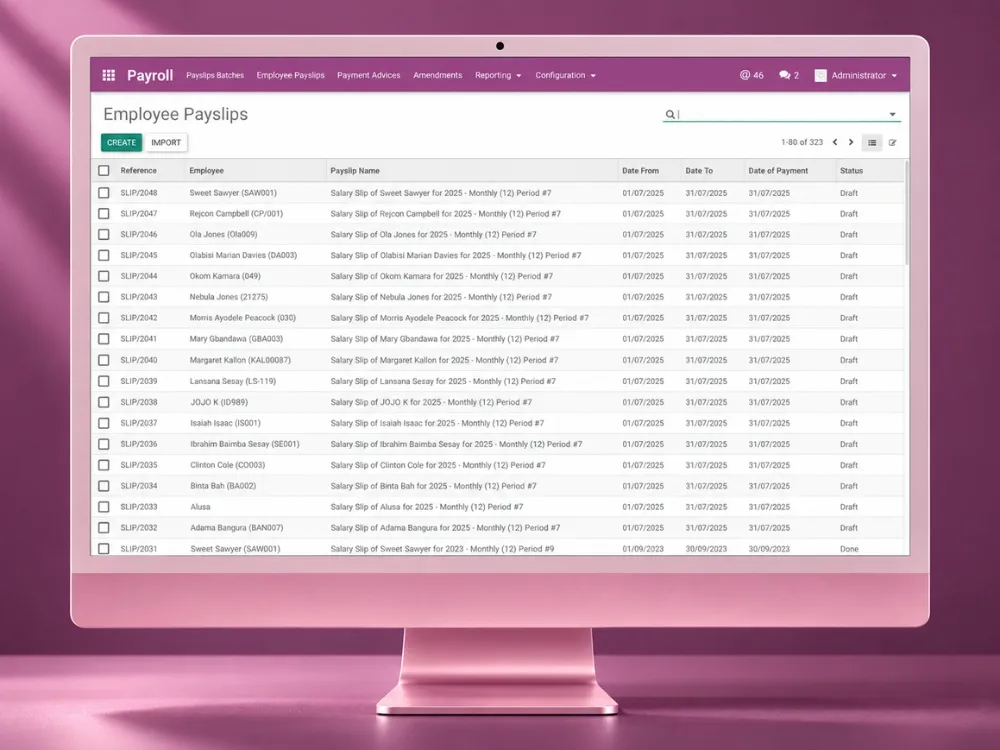
Odoo business applications

Odoo Human Resources, From Hiring to Payroll and Performance

HR in an ERP earns its place when the employee record drives the timesheet, the leave balance, the expense claim and the payslip from the same data. This page shows how we connect that, and it is specific about payroll, which is the part nobody should promise in general.

  • Employees
  • Recruitment
  • Attendance
  • Leave
  • Appraisals
  • Payroll

Reviewed by Bhavesh Selarka, COO & Co-Founder, Heliconia Solutions · Odoo 16 Functional Certification · Odoo Partner · Updated

Proof

Payroll built for four labour jurisdictionsAn HRIS SaaS on Odoo, 8+ yearsAttendance devices integratedCommunity + EnterpriseHonest about localisation

Clients

Businesses that run on what we built

  • Jo Ann's
  • Opsio
  • Mevalon Produkte
  • TIMmunity GmbH
  • Aria Jewellers
  • Freiburger Bund
  • LittleQ

The short answer

What Does an Odoo HR Implementation Cover?

It covers the employee lifecycle inside the same system that runs the rest of the business: recruitment, the employee record, contracts, attendance, leave, expenses, appraisals and, where the country is supported or built, payroll. The gain is one employee record feeding timesheets, project costs and the ledger. The caution is payroll, which is jurisdiction-specific and has to be assessed country by country.

Most businesses don't move to Odoo for HR. They move for operations, then discover that the timesheet, the expense claim and the payroll line all describe the same person in three systems. Putting HR on the same platform removes that reconciliation, and it makes project profitability real rather than approximate.

We are deliberately careful about payroll on this page. We have built localised payroll for four Caribbean jurisdictions and automated payroll and overtime for a Swedish managed-services business, and that is exactly the point: payroll is built or verified per country, never assumed.
The connected workflow

The Employee Lifecycle in Odoo

One record, from the job advert to the payslip. Each step names the app that carries it, or the custom work when the standard flow does not fit.

  1. Step 01

    Recruitment

    Job positions, applications, interview stages and offers. The accepted candidate becomes the employee record rather than being retyped into one.

    • Recruitment
  2. Step 02

    Onboarding and the employee record

    Contracts, departments, managers, working schedules, documents and access. This record is the single source everything downstream reads.

    • Employees
  3. Step 03

    Attendance and time

    Check-in and check-out from the app, a kiosk or a device on the wall, with working schedules and overtime rules applied to the raw data.

    • Attendance + devices
  4. Step 04

    Leave and absence

    Allocation, requests, approval chains and balances that reflect your policy, visible to the manager who has to plan around them.

    • Time Off
  5. Step 05

    Timesheets and project cost

    Hours booked to projects and tasks, which is where HR stops being an administrative function and starts driving profitability.

    • Timesheets, Project
  6. Step 06

    Expenses

    Claims captured, approved against policy, posted to the right analytic account and paid through the same ledger as everything else.

    • Expenses
  7. Step 07

    Appraisals and development

    Review cycles, objectives and feedback, kept with the employee record instead of in a separate tool nobody opens.

    • Appraisals
  8. Step 08

    Payroll

    Where the country is supported or we build it: contracts and rules produce payslips, then accounting entries. This is the step that needs a country-by-country answer.

    • Payroll + localisation

The two steps that decide whether HR in Odoo is worth it: attendance data that people actually trust, and payroll that is legal where you operate. Everything between them is straightforward.

Grouped by job

What We Build on the HR Side

Each item is from a system in production, with the client named.

  • Payroll localised per jurisdiction

    Jo Ann's runs island-localised payroll engines built to the labour rules of Aruba, the Bahamas, Curaçao and St. Maarten, on one Odoo 16 Enterprise platform with four legal entities.

    • Four jurisdictions
    • Per-entity rules
    • Ledger posting
  • Payroll and overtime automation

    Opsio automates payroll calculations and overtime processing on Odoo 18 Enterprise, alongside projects, timesheets and helpdesk, so labour cost lands where the work happened.

    • Automation
    • Overtime rules
    • Leave reminders
  • A full HRIS on Odoo

    iDT Labs runs an HRIS SaaS on Odoo Community that we have supported for over eight years: employee management, attendance, leave, payroll customisations, recruitment workflow, an employee self-service portal and HR reporting.

    • Self-service portal
    • Multi-client SaaS
    • HR dashboards
  • Attendance hardware and integrations

    Biometric and card devices, kiosks and payroll integrations wired into the employee record, so the raw punches become hours the payroll engine can use. Built for the iDT Labs HRIS.

    • Attendance devices
    • Payroll interfaces
    • Clean hours
  • Incentives and commissions

    Pay that depends on performance modelled properly: Aria Jewellers runs an employee incentive module, and Jo Ann's tracks POS user commissions automatically at the till.

    • Incentives
    • POS commission
    • Auditable
  • Privacy and access control

    HR data is the most sensitive data in the system. Record rules, restricted fields and per-entity access are designed in, not added after someone sees a salary they should not have.

    • Record rules
    • Per-entity access
    • Document handling

The honest three columns

Standard, Configuration or Custom Engineering?

HR has the widest gap between "Odoo has an app for that" and "Odoo does that the way your country requires". This is the order we try things.

Standard, Configuration or Custom Engineering?
RequirementStandard OdooConfiguration or OCACustom engineering (and why)
Employee records and contractsYes, fullyFields, departments, working schedules, document typesRarely, beyond extra fields your process needs
RecruitmentJob positions, applications, stagesStages, interview forms, email templatesApproval chains and client-specific flows, as in Jo Ann's recruitment tracking
AttendanceCheck in and out, kiosk modeWorking schedules, overtime rules, tolerancesDevice integration and shift patterns that standard schedules cannot express
Leave and absenceAllocations, requests, approvalsLeave types, accrual plans, approval chainsLocal entitlement rules and carry-over policies that differ per entity
AppraisalsEnterprise Appraisals appTemplates, cycles, questionsOn Community, or when the review process feeds pay
PayrollDepends entirely on the countryLocalisation package where one existsA payroll engine per jurisdiction, which is what we built for four Caribbean territories
Incentives and commissionNot reallyLimited, through reportingUsually custom: the rules are specific to your business, as at Aria Jewellers

Read the payroll row carefully. Everything above it is broadly portable between countries. Payroll is not, and any partner who tells you otherwise has not implemented it in yours.

Edition and OCA

Community, Enterprise or OCA for HR?

HR is the family with the largest Enterprise advantage, so it deserves a direct comparison before you decide.

Community, Enterprise or OCA for HR?
CapabilityCommunityEnterpriseNotes
Employees, contracts, departmentsYesYesCore in both
RecruitmentYesYesIn both
Time Off (leave)YesYesIn both
AttendanceYesYesIn both. Device integration is custom either way
ExpensesYesYesIn both
AppraisalsOCA or customYesEnterprise app. OCA covers part of it
PayrollOCA or custom per countryLocalised where Odoo supports the countryThe single biggest edition question in this family
Employee self-service portalCustom, as built for iDT LabsYesPortal depth differs
Planning and shift scheduling–NoYesEnterprise app

If payroll is in scope, check whether Odoo publishes a localisation for your country before anything else. That one answer usually decides the edition and a good part of the budget.

Data and boundaries

What We Migrate, and Where the System Ends

  • Employee master data: people, contracts, departments, managers, working schedules and documents, cleaned before load
  • Leave balances at the cut-off date, agreed with HR, because a wrong balance is noticed on day one
  • Open recruitment pipelines so live candidates are not lost at cutover
  • Historical payroll: normally kept in the outgoing system as a read-only record rather than migrated line by line
  • Integration boundary named per system: attendance devices, payroll bureaux, benefits providers, banks
  • What stays outside: statutory filing, employment-law advice and anything your payroll bureau is contracted to do

How we run it

The Implementation Sequence

  1. Localisation check first

    Before design, we establish what Odoo supports for payroll in each country you operate in, and what would have to be built or kept with a bureau. That answer shapes everything after it.

  2. Workflow discovery

    We follow one hire, one leave request, one expense claim and one pay run end to end with the people who process them, including the manual steps nobody documents.

  3. Design decisions

    Working schedules, overtime and accrual rules, approval chains, who can see what, and how HR data is separated per entity. Written down with the reasoning.

  4. Configuration and build

    Standard apps configured, OCA where it fits, then custom modules for payroll rules, device integration or incentive logic that is genuinely yours.

  5. Parallel pay runs

    Where payroll is in scope we run it in parallel with the existing process for at least one cycle, and compare payslip by payslip. Nobody goes live on a single untested run.

  6. Go-live and the first cycle

    Cutover with a rollback path, then close support through the first full pay run, the first month-end and the first leave-approval cycle.

Evidence

HR Systems We Run in Production

Only projects where the HR workflow described above is actually in place.

HR Systems We Run in Production
ProjectIndustryOdooKey capabilitiesTechnology
Jo Ann'sRetail & wholesale, duty-freeOdoo 16 EnterpriseJoanns Base · Joanns POS · Joanns POS User Commission · Joanns POS WholesaleOdoo 16 Enterprise · Python · PostgreSQL · OWL / QWeb · POS blackbox middleware
OpsioCloud managed servicesOdoo 18 EnterpriseCash Flow Forecast Report · Working Capital Report · Timesheet Profitability · Project ProfitabilityOdoo 18 Enterprise · Python · PostgreSQL · JavaScript · REST APIs
iDT LabsICT consulting & software: HRIS SaaSOdoo 9 CommunityHRIS SaaS Management · Employee Management · Attendance Management · Leave ManagementOdoo 9 Community · Python · PostgreSQL
Aria JewellersJewellery retail & manufacturingOdoo EnterpriseJewellery Management Base · Jewellery Account · Jewellery Account Payment Mode · Jewellery AppOdoo Enterprise · Python · PostgreSQL · GraphQL (Graphene) · OWL / QWeb

Read the projects

Three HR Problems, Three Systems

Payroll across four labour jurisdictions, payroll and overtime automation inside a services business, and an HRIS SaaS on Odoo supported for over eight years.

All case studies

Workflow review

Request an HR Workflow Review

Send us your headcount, the countries you employ in, how you capture time, and whether payroll is in scope. You get the workflow mapped to Odoo, a straight answer on payroll localisation for each country, and what we would configure versus build. No obligation.

  • Employee lifecycle mapped to Odoo apps, with the gaps named
  • A payroll answer per country: supported, buildable, or keep your bureau
  • Attendance approach for your sites, including device integration
  • Access and privacy model for HR data across entities
  • Migration plan for employees, balances and open recruitment

Request the review

What clients say

In Their Words

Questions

Odoo HR Questions, Answered Directly

Bhavesh Selarka

COO & Co-Founder, Heliconia Solutions

Not answered here? Ask Bhavesh directly, the person who reviewed this page, not a sales queue. Odoo 16 Functional Certification.

Ask a question

Can Odoo run our payroll?

It depends on the country, and that is the only honest answer. Odoo publishes payroll localisations for some countries and not others, so the first thing we check is whether yours is one of them.

Where it is not, payroll is a build. We have done that: Jo Ann's runs payroll engines we built to the labour rules of Aruba, the Bahamas, Curaçao and St. Maarten. What we will not do is promise a global payroll implementation.

Read the multi-jurisdiction project

Do we need Odoo Enterprise for HR?

Not for the basics. Employees, recruitment, leave, attendance and expenses are in Community. Appraisals, Planning and the published payroll localisations are Enterprise, and payroll is usually what decides it.

iDT Labs runs a full HRIS, including payroll customisations and an employee self-service portal, on Odoo Community, so the Community route is real when the payroll answer is custom anyway.

Community vs Enterprise

Can Odoo read our biometric or card attendance devices?

Usually, through an integration rather than out of the box. The work is in turning raw punches into hours your policy recognises: shifts, tolerances, breaks and overtime rules. We built exactly this for the iDT Labs HRIS, including the payroll interfaces behind it.

How do we keep salary data private when everyone is in one system?

Record rules and field-level access, designed at the start. Managers see their own team, HR sees the function, finance sees the postings and nobody else sees the payslip. In multi-entity systems the boundary is per entity as well as per role.

This is configuration plus testing, and we test it by trying to see what we should not.

Does HR in Odoo make project costing more accurate?

Yes, and for services businesses that is often the real reason to do it. When timesheets come from the same employee record as contracts and leave, project profitability reflects actual paid hours. Opsio runs timesheet and project profitability reporting on exactly that basis.

Projects and service operations

Can we keep our payroll bureau and still use Odoo for HR?

Yes, and it is often the sensible first phase. Odoo holds employees, contracts, attendance, leave and expenses, then exports what the bureau needs. You get one employee record without taking on payroll compliance in the same project.

Moving payroll in later is a decision you can make once the rest is stable.

How long does an HR implementation take?

Employees, leave, attendance and expenses are usually a matter of weeks. Payroll changes that completely, because it needs a localisation check, rule building and at least one parallel run before go-live. We scope it after the localisation answer, not before.

Estimate the scope

The rest of the chain

This Department Does Not Run Alone

Odoo earns its place at the hand-offs between departments, not inside any one of them. These are the families this one exchanges data with every day.

Next step

Get a Straight Answer on Payroll Before You Plan Anything

Tell us your headcount, the countries you employ in and how you capture time. We will tell you what Odoo covers, what we would build, and what should stay with your bureau.